
Certificat d’aptitudes pédagogiques
Cette section vise à permettre à de futurs enseignants de :
- mettre en œuvre un langage oral et écrit et une communication verbale et non verbale adéquats et corrects ;
- développer des compétences relationnelles liées aux exigences de la profession ;
- concevoir des dispositifs d’enseignement, les tester, les évaluer et les réguler ;
- porter un regard réflexif sur leur pratique et organiser leur formation continue …
Débouchés :
Cours technique et de pratique professionnelle de l’enseignement secondaire
Titre délivré à l’issue de la formation :
Certificat d’aptitudes pédagogiques
Conditions d’admission :
Le décret du 11/04/2014 réglementant les titres et fonctions dans l’enseignement fondamental et secondaire organisé et subventionné par la Communauté française (et ses modifications) impose à l’étudiant de détenir
- Soit un certificat d’enseignement secondaire supérieur (CESS) qui permet d’accéder à une fonction de recrutement dans l’enseignement.
- Soit un titre de l’enseignement supérieur qui permet d’accéder à une fonction de recrutement dans l’enseignement. Les porteurs d’un master ouvrant l’accès à l’agrégation de l’enseignement secondaire supérieur devront se diriger vers l’Université de leur choix (voir communication de Monsieur STOLZ, Directeur général de l’Enseignement de Promotion sociale)
Remarques:
- Un candidat qui ne détient pas de CESS mais dont le certificat lui permet d’accéder à une fonction de recrutement dans l’enseignement devra suivre au préalable l’unité d’enseignement « Expression orale et écrite en français orientée vers l’enseignement (981011U36D3) ». Cette unité n’est pas organisée à l’institut d’enseignement de promotion sociale de Morlanwelz et doit donc être suivie dans un autre institut.
- Un candidat pourra aisément connaître les fonctions qu’il peut exercer en consultant sur le site www.enseignement.be la page « Etre enseignant : quelle fonction puis-je exercer dans l’enseignement ? »
- Est en possession du CESS le candidat qui a réussi une sixième année d’humanité générale, technique ou artistique ou qui a réussi une septième année professionnelle.
- Certains certificats de qualification de l’enseignement secondaire supérieur de promotion sociale permettent d’obtenir le CESS en réussissant la formation « Complément de formation générale en vue de l’obtention du certificat correspondant au certificat d’enseignement secondaire supérieur ». Cette formation n’est pas organisée à l’eafc de Morlanwelz. Elle peut être suivie à l’IEPSCF Thuin.
Descriptif de la formation :
La formation est étalée sur deux ans minimum et comprend :
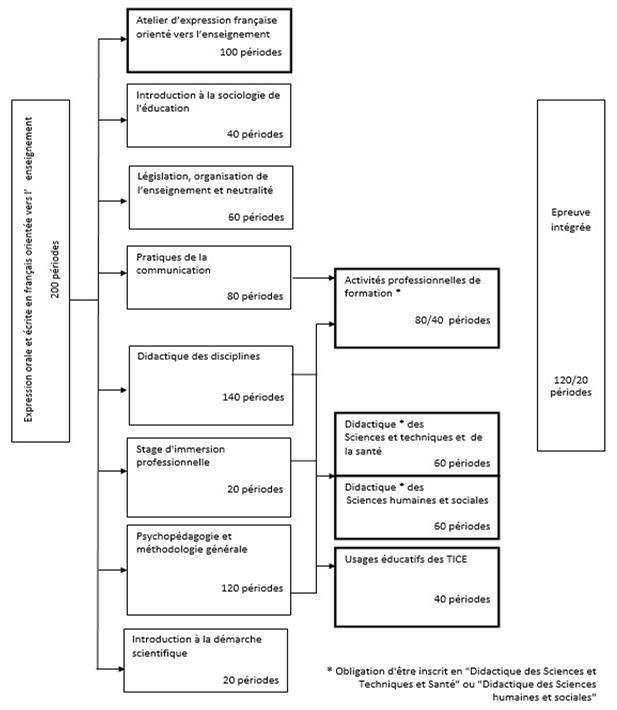
- 660 périodes de cours minimum tels : Méthodologie, psychopédagogie, didactique, organisation et législation, pratique de la communication, sociologie, …
- 100 périodes de stages ;
- 120 périodes de préparation à l’épreuve intégrée ;
Attestations d’irrecevabilité à l’agrégation
Le Conseil d’Administration de l’ARES, en sa séance du 10 juillet 2018, a pris attitude sur la délivrance, par les universités d’une attestation d’irrecevabilité permettant aux candidat.e.s de s’inscrire au CAP.
Ainsi, le Conseil d’Administration de l’ARES a validé la proposition suivante : des attestations d’irrecevabilité à l’agrégation de l’enseignement secondaire supérieur seront délivrées aux demandeurs satisfaisant à l’une des deux conditions suivantes :
- le demandeur ne dispose pas du diplôme requis pour entamer l’agrégation ;
- les conditions d’organisation ne permettent pas au demandeur de suivre les cours et de continuer à exercer son activité professionnelle en même temps.
La délivrance des attestations d’irrecevabilité ne perdurera, sous sa forme actuelle, que jusqu’à la mise en œuvre du décret relatif à la Formation Initiale des Enseignants.
Dès lors, toute personne en possession d’une attestation d’irrecevabilité pourra être inscrite dans le cursus du CAP organisé par l’enseignement de promotion sociale, dans les conditions définies supra.
Organigramme de la section :
Dossiers pédagogiques :
Dossier pédagogique de la section (document 8 ter)
Activités professionnelles de formation
Atelier d’expression française orienté vers l’enseignement
Didactique des Sciences et techniques et de la santé
Didactique des Sciences humaines et sociales
Introduction à la démarche scientifique
Introduction à la sociologie de l’éducation
Législation et organisation de l’enseignement
Psychopédagogie et méthodologie générale
Stage d’immersion professionnelle
Usages éducatifs des technologies de l’information et de la communication pour l’enseignement – TICE